
Pulaski Criminal History Checks
Pulaski has no verified public police-report portal, arrest blotter, police app, or municipal case-search screen. The useful path is a short chain of official contacts. Begin at the city for a city event, then follow custody or prosecution to the office that received it. Give each custodian a narrow request so staff can identify the record without guessing.
- Use the Pulaski department directory or city switchboard to reach the police custodian for an incident or arrest report.
- Describe the event by date, approximate time, street, involved name, officer, and report number when known.
- Call the City Court Clerk for a Pulaski ordinance or municipal traffic citation.
- For a booking or state charge, check the Giles County Jail and Circuit Court Clerk.
- Use TORIS only when a statewide Tennessee name-based history adds value.
A custody result is not a final outcome. The jail can confirm intake and bond, but the court file shows whether a charge was filed and how it ended. Pulaski police may hold the narrative even when county offices hold the later booking and docket.
Pulaski's Three-Counter Record Trail
Pulaski's compact downtown can make the system look unified. It is not. The Municipal Building at 203 South First Street houses city functions, while the Giles County Courthouse at 1 Public Square holds Circuit and General Sessions dockets. The county jail is at 200 Thomas Gatlin Drive. A single arrest can therefore produce files at three counters.
The first question is what happened. A Pulaski police response creates a city report. If officers take someone into custody, the Giles jail creates a booking record. If prosecutors pursue a state offense, the county clerk opens or updates a General Sessions case, with an indicted felony later moving through Circuit Court. A city citation stays in Pulaski City Court. Physical closeness does not merge ownership.
For the broader county route, the Giles County criminal history overview explains clerk, jail, TBI, and correctional sources without changing who owns the original Pulaski report.
Records at Pulaski Police
Pulaski Police creates local incident, arrest, and crash reports. Kenneth Bass is listed as police chief in the current state-supported municipal directory. No separate records-unit page or dedicated request form was verified. Route a request through the official Pulaski departments page or the city switchboard at 931-363-2516. Ask for the police records custodian and state the record component sought.
A useful request distinguishes the narrative, arrest sheet, crash report, CAD event, audio, or video. Each part can have different review work and redactions. Include the date, approximate time, location, names, officer if known, and report or citation number. If staff refer the requester to Giles County, ask which component moved. The county jail may hold booking data while Pulaski Police still holds the originating report.
The official Pulaski department directory provides the verified city route for police contacts.
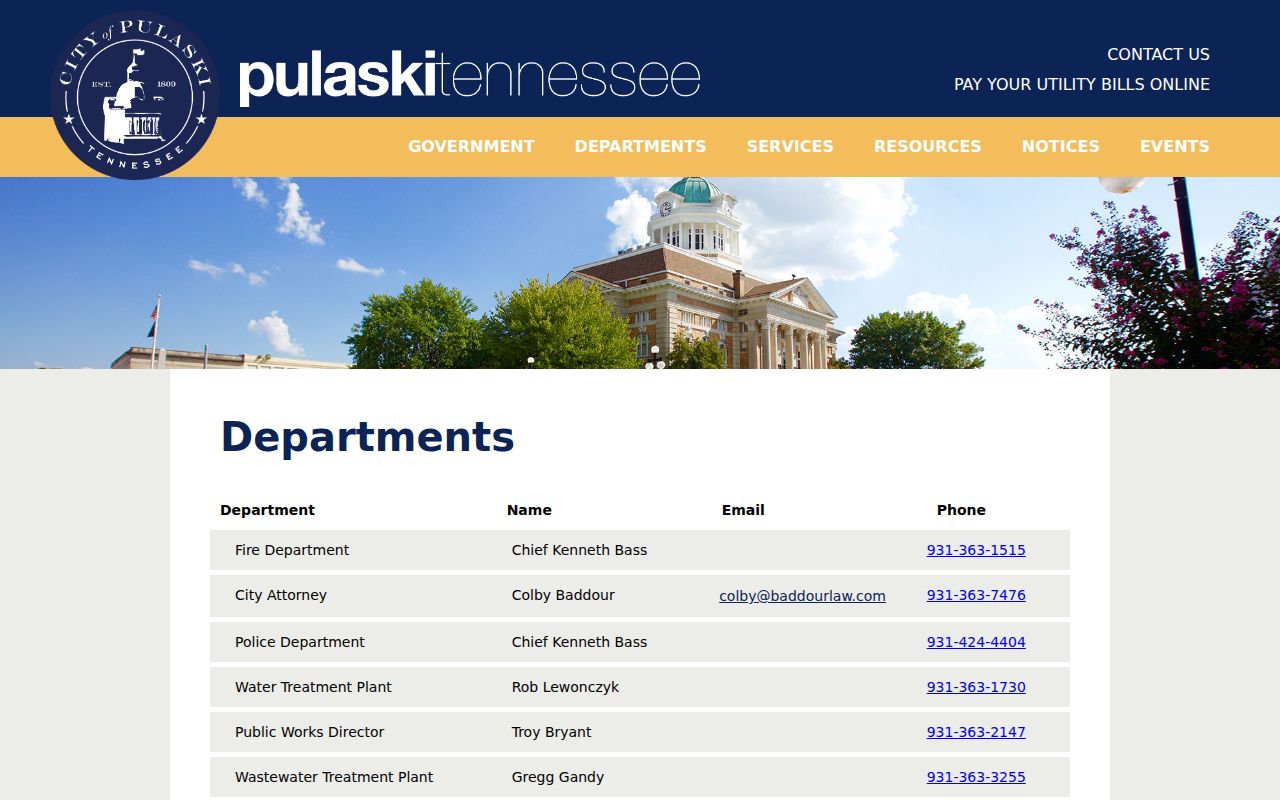
The directory is a contact gateway, not a public case or report database.
Pulaski Records at City Hall
The Pulaski Municipal Building is at 203 South First Street, P.O. Box 633, Pulaski, TN 38478-0633. The city phone is 931-363-2516, and the published fax is 931-363-3408. Office hours are Monday through Wednesday and Friday from 8:00 a.m. to 4:30 p.m., with Thursday hours from 8:00 a.m. to 4:00 p.m. Call before travel because the police or court custodian may follow a different schedule.
The state-supported municipal profile lists Sesonnya Williams as City Court Clerk and Rogers N. Hays or Hayes as city judge, with spelling varying across official municipal data. MTAS lists 931-424-4404 for the City Court Clerk, but the research calls for verification before relying on it. The main city line is the sound fallback. Ask whether inspection, ordinary copies, or a certified court copy is needed and how payment is accepted.
The MTAS Pulaski profile shows the municipal offices and current contact framework.
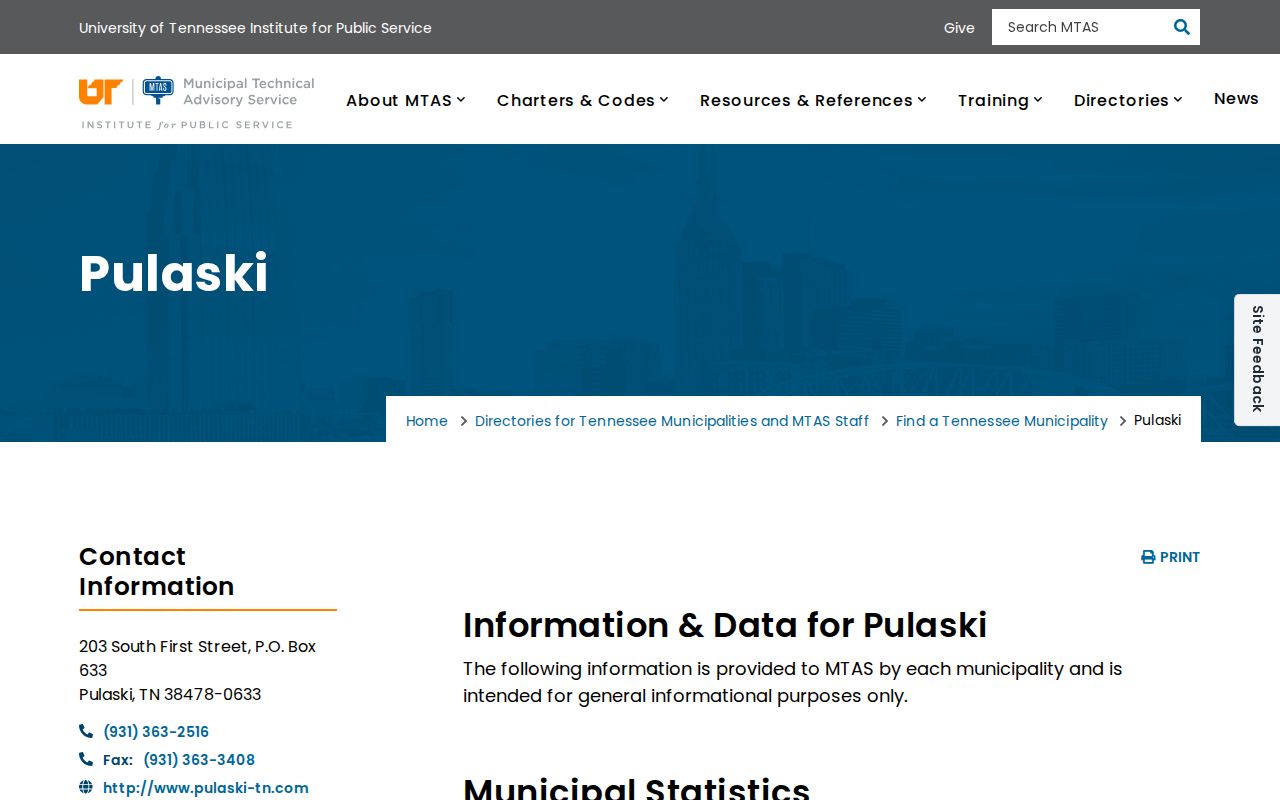
It helps identify the city office before a requester follows a state case to the county clerk.
Note: Verify the Pulaski City Court Clerk's direct number and the current session schedule before planning an in-person records visit.
Booking and Arrest Records in Pulaski
Pulaski does not advertise a separate long-term city jail. Custodial arrests route to the Giles County Jail. That move creates two distinct records. Pulaski Police keeps the officer's account and city identifiers. Jail staff create an intake record with booking date and number, arresting agency, charges accepted at intake, bond, custody status, fingerprints, and photograph.
For a very recent Pulaski arrest, call the Giles County Jail at 931-363-3505 with the full name and approximate event time. Ask for the booking identifier, charges, bond, custody status, and assigned court. Then return to Pulaski Police for the incident or arrest report. Finally, call the county clerk if a state charge produced a General Sessions docket. The full Giles County arrest search process gives added detail for county booking records.
An arrest allegation can change. Prosecutors may amend, replace, dismiss, or decline a charge, and an indicted felony creates a later Circuit Court phase. Do not read the Pulaski booking label as a conviction.
Pulaski City or State Charge
The issuing paper is the best first clue. Pulaski City Court handles city ordinances and municipal traffic within its legal jurisdiction. It does not try indicted felonies. A state misdemeanor or felony belongs with the Giles Circuit Court Clerk, even when Pulaski Police made the arrest. One event may create both a municipal citation and a state case, so ask for each number separately.
Use the Pulaski municipal code to understand the court's grant of authority, but use the actual docket to learn what was filed. A code provision describes jurisdiction. It does not prove that a person was cited, found liable, or convicted. If the citation shows a city case, call the City Court Clerk. If the paperwork lists General Sessions or a state statute, call the county clerk at 931-363-5311.
- Municipal citation
- A city-issued matter tied to an ordinance or municipal traffic authority.
- State charge
- An alleged Tennessee offense processed in General Sessions and, for indicted felonies, Circuit Court.
- Docket
- The court's chronological record of filings, events, status, and outcome.
The Pulaski Municipal Court File
Pulaski City Court records should be requested from the city clerk channel. Because no public case-search interface was verified, prepare enough information for a counter or phone search. A name, citation or case number, date, and birth date when the clerk lawfully requests it can help distinguish the file. Ask for a docket entry first, then identify the exact judgment, order, or citation copy needed.
| Court Name | Pulaski City Court |
|---|---|
| Case Types Heard | Municipal ordinance and traffic matters within city jurisdiction |
| Case Lookup Channel | City Court Clerk by phone or municipal counter; no verified public portal |
| What the File Shows | Citation or case number, charge or ordinance, events, status, disposition, and money entries as maintained |
| Copies and Fees | Ask the clerk about inspection, plain or certified copies, current charges, and payment method |
A City Court result does not replace a separate General Sessions or Circuit outcome. If an event produced both city and state papers, search both custodians.
Pulaski's 1809 Records Geography
Pulaski incorporated in 1809 and serves as the Giles County seat. Its long civic role explains why city and county offices sit close together, yet the historic record trail follows government authority, not distance. City Hall keeps municipal and department files. The county courthouse keeps county trial-court dockets. The jail keeps custody records. TBI keeps the fingerprint-supported statewide history.
That geography is useful for old Pulaski matters. A city ordinance file may remain with municipal records, while an older state prosecution requires clerk retrieval at 1 Public Square. The county does not publish a comprehensive online trial-case portal, and Pulaski has no verified municipal lookup. Alternate name spellings, the approximate year, charge type, and likely court level can save time when staff search older indexes.
The city and county population series also differ slightly by method and vintage. Pulaski's 2025 Census estimate is 8,394, while Tennessee's certified municipal figure is 8,397. Neither count says anything about an individual's record.
How Pulaski Records Reach the County
A Pulaski state case crosses systems in stages. Police create the first report. The jail adds custody data when there is a custodial arrest. General Sessions handles early state proceedings and misdemeanors. An indicted felony moves into Circuit Court. The clerk reports dispositions so TBI can append an outcome to the arrest cycle in its state repository.
Record flow: Pulaski Police › Giles County Jail and Courts › Tennessee Bureau of Investigation
This sequence explains timing gaps. The police report can exist before a docket appears. The jail can show intake before prosecutors make a final charging choice. TORIS can lag if fingerprints or a disposition are not matched. For a recent Pulaski event, start local. For the final legal outcome, read the court judgment. For a Tennessee-wide name check, use TORIS only after understanding its limits.
Fields That Find Pulaski Records
Broad requests slow the search and can ask the city to create a compilation it does not maintain. Identify a Pulaski event by the facts that already belong to it. State whether inspection or copies are wanted, name the police or court record, and separate each media type. A report narrative, booking sheet, CAD entry, video, and court judgment are not one document.
| Pulaski Channel | Useful Identifiers | Status |
|---|---|---|
| Police report | Date, time, street, involved name, officer, report number, requested component | No dedicated form verified |
| Municipal case | Name, citation or case number, date, and identifier requested by clerk | No public lookup verified |
| City contact | Requester contact, department, concise subject and message | Use official department route |
Ask about redactions before ordering audio or video. Active investigative facts, juvenile material, victim data, and protected identifiers may be withheld under law.
Reading Pulaski Crime Records
Use TBI CrimeInsight with the Pulaski agency and year selected. Do not prorate Giles County crime totals to the city or claim that the county clearance rate measures Pulaski Police. An incident, offense, arrest, booking, filed case, clearance, and conviction are different units. One incident can involve several offenses, and a cleared offense can end without a conviction.
When citing city context, save the agency filter, year, and metric. Compare full years with the same definition. For a person's history, skip area rates and use the actual Pulaski report, court docket, and final judgment. Local statistics can show agency workload or broad trends, but they cannot identify whether a named person has a record. A clearance may occur by arrest or exceptional means, so it must not be restated as a Pulaski conviction count. The city agency filter must also stay distinct from the countywide total.
Pulaski Record Access Rules
Pulaski records are subject to Tennessee access law, but the correct custodian controls the response. Tennessee citizens may inspect public records unless a statute makes them confidential. City staff may require proof of citizenship and may redact protected data. A city police report stays with Pulaski; a county booking stays with the sheriff; a city docket stays with the municipal clerk.
Key Statutes:
T.C.A. §10-7-503 gives Tennessee citizens inspection rights for nonconfidential public records.
T.C.A. §10-7-504 identifies confidential records and protected information.
Tennessee Supreme Court Rule 34 governs public and electronic access to court records.
Ask for a written explanation when access is denied or delayed. A narrow request makes it easier to identify the legal basis for any redaction.